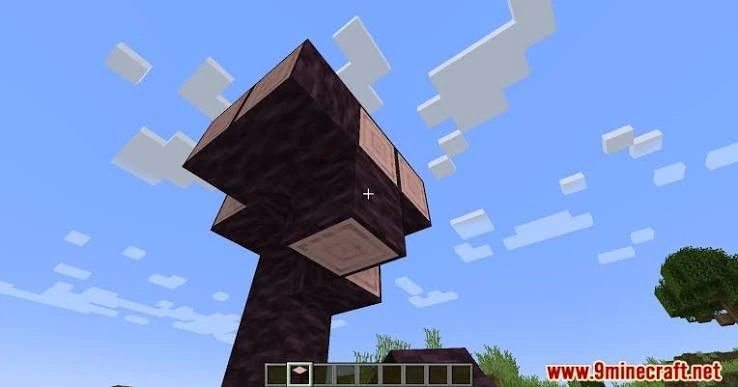
Start with a simple orientation test
Use blocks whose orientation is easy to see and place them on multiple faces. A short test confirms whether the active profile behaves consistently before you commit to a large structure.
Keep camera motion deliberate
Rapid camera swings can make any placement workflow harder to judge. Align the crosshair, confirm the target surface, then place. Once the result is predictable, increase your pace.
Test awkward faces separately
Undersides, ledges and side faces are good stress tests for building control. Practice them in creative mode or a throwaway area so mistakes do not damage a finished build.
Change one variable at a time
If behavior seems wrong, avoid changing loader, keybinds, game version and multiple mods at once. Isolate the issue so you can tell whether it comes from compatibility, a conflict or simple input timing.
Build a small repeatable test course
A useful precision test does not need a large world. Create a short line of blocks, a corner, an overhead placement point and a compact cluster. Repeat the same sequence several times while keeping your movement and hotbar order consistent. A fixed test course makes it easier to notice whether a change in camera angle or input timing actually improves your workflow.
Use the same block type during the first tests so texture and inventory changes do not distract from placement. Once the movement feels consistent, repeat the course with stairs, logs or directional blocks if those are part of the build you plan to make.
Separate aiming from movement
When a placement feels unreliable, test one variable at a time. Stand still and adjust only the camera, then keep the camera stable and change your movement path. This simple separation helps identify whether the difficult part is crosshair position, viewing angle, movement timing or the geometry around the target face.
- Approach the same target from two or three known angles.
- Keep sensitivity settings unchanged while comparing attempts.
- Use a consistent hotbar slot for the test block.
- Slow down near edges, overhangs and tightly packed structures.
Turn precision into a building routine
Once a test sequence feels predictable, reuse that rhythm in larger builds. Work in short sections, complete one repeated pattern, then visually check alignment before continuing. This keeps small placement mistakes from propagating across a long wall or decorative pattern.
Accuracy and speed usually improve together when the routine is stable. The goal is not to click as quickly as possible; it is to reduce corrections, block breaking and re-placement so the overall construction process becomes smoother.
Review the result after each short section
A quick visual check after a small run of blocks is one of the easiest ways to keep a large build accurate. Look for orientation, spacing and alignment before moving on. If something feels inconsistent, repeat the same short sequence rather than continuing and creating more corrections later.
Over time, keep the camera path and hotbar order that produces the fewest corrections. A repeatable process matters more than copying someone else’s sensitivity or movement style because different mouse settings, field of view and build geometry can change what feels comfortable.